← All posts · Braking and pedals
What Is Trail Braking? How It Works in Sim Racing, Step by Step and in Telemetry
Short answer: trail braking means you keep some brake pressure as you turn into a corner and release it gradually toward the apex, instead of finishing all your braking in a straight line. The remaining brake pressure keeps weight on the front tires, which gives them more grip, so the car turns in better and you can brake later. Done well, it is faster in most corners. Done badly, it causes understeer, locked front wheels or a spin.
This guide explains why it works, how to learn it step by step, what it looks like in your telemetry, the most common mistakes, and how it changes between GT3 cars with ABS, formula cars and rear-engined cars.
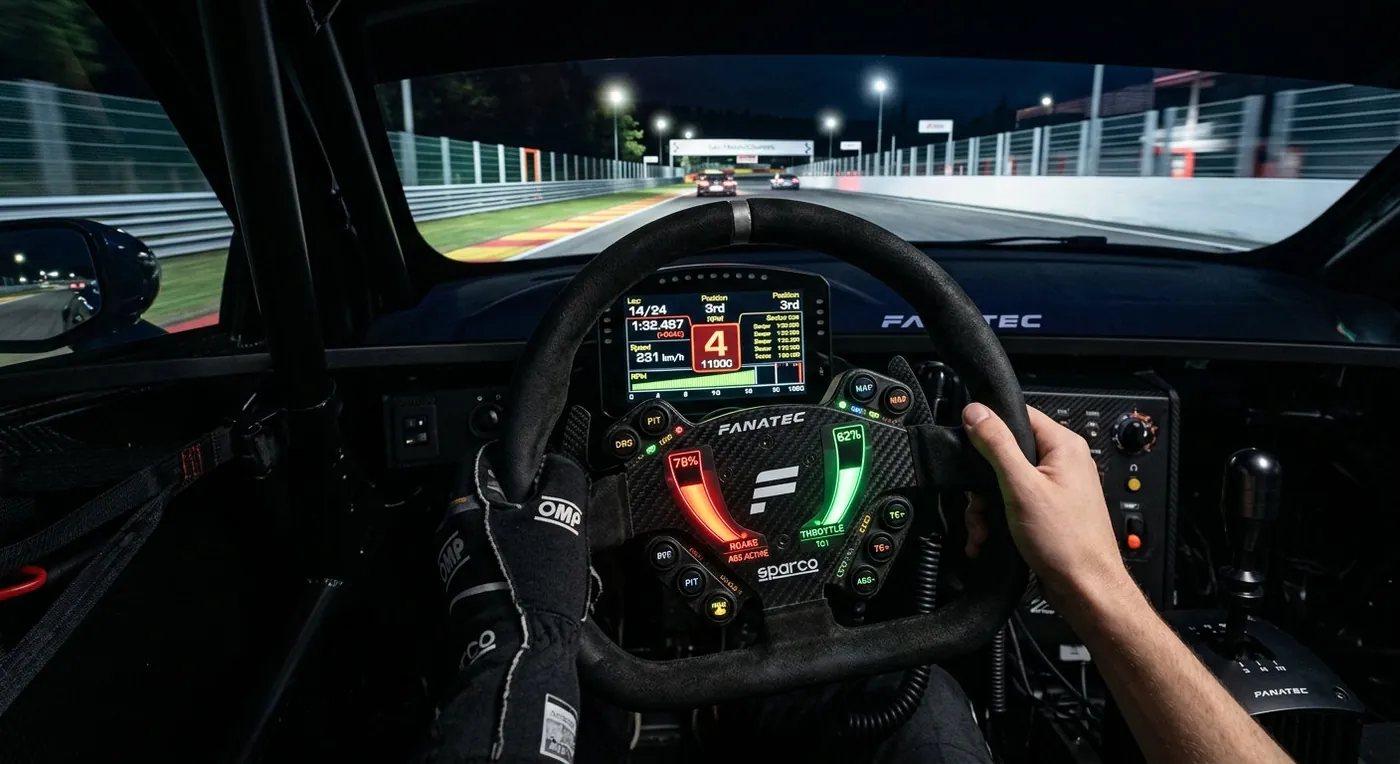
Trail braking vs straight-line braking
| Straight-line braking | Trail braking | |
|---|---|---|
| When braking ends | Before you turn the wheel | Around the apex, after turn-in |
| Brake release | Quick, usually all at once | Gradual, while steering increases |
| Front grip at turn-in | Lower: weight has moved back | Higher: weight is still on the front |
| Braking point | Earlier | Later |
| Risk | Low, but slower | Understeer or a spin if the release is wrong |
| Best for | Learning a new track, very slow hairpins in low-grip conditions | Most corners once you know the track |
Straight-line braking is not wrong. It is the safe default while you learn a track. Trail braking is the next step: it uses the same braking zone, but it keeps the brake working into the first part of the corner.
Why trail braking works: weight on the front tires
A tire's grip depends on how much load is pressing it into the road. When you brake, weight moves forward and the front tires get more load, so they have more grip. When you release the brake, the weight moves back and the front tires lose some of that grip.
If you release the brake completely before turning in, the front tires reach the corner with less load just when you ask them to steer. The car is slower to turn and often understeers. If you keep a little brake pressure as you turn in, the front stays loaded and the car rotates more easily.
The second part is the grip budget. A tire can only give so much grip in total, and that grip is shared between braking and turning. At the start of the braking zone you use almost all of it to slow down. As you add steering, you need to give back braking grip so the tire can use it for cornering. That is why the brake release has to be gradual: brake pressure goes down while steering goes up.
How to trail brake, step by step
- Start from your normal braking point. Do not brake later yet. Learn the release first, then move the braking point.
- Hit peak pressure early. Press the brake firmly at the start of the zone, while the car is straight and the tires can take the most braking.
- Start releasing before you turn. Ease off the brake progressively through the second half of the zone, so the car is not at full pressure when you turn the wheel.
- Turn in with some brake still applied. Keep a light, steady pressure as you add steering. The car should feel like it rotates toward the apex.
- Finish the release near the apex. Brake pressure goes to zero as steering reaches its maximum. Then go to the throttle with as little coasting as possible.
- Only then brake later. Once the release is consistent, move your braking point a few meters at a time and check the minimum corner speed in your data.
Practice in one corner at a time, ideally a medium-speed corner with a clear braking marker. A tight hairpin and a fast sweeper both hide mistakes. If you struggle to judge braking points in the first place, read our guide to braking points and speed perception first.
What trail braking looks like in telemetry
Trail braking is hard to judge by feel because the release happens while you are busy steering. Telemetry makes it visible. Put the brake trace and the steering trace on the same chart for one corner:
- Good trail braking: the brake trace rises quickly to its peak, then slopes down in a smooth ramp. The steering trace starts rising while the brake is still above zero, and the two lines cross before the apex.
- No trail braking: the brake trace drops to zero before the steering starts to rise. There is a gap between the end of braking and the start of turning.
- Release too sudden: the brake trace falls in a near-vertical step at turn-in. The car loses front grip at once, so you usually see extra steering lock right after.
- Too much brake too long: the brake stays high deep into the corner, the minimum speed point comes late, and the steering trace shows corrections as the front tires slide.
- Coasting: a flat section where both brake and throttle are near zero between the end of braking and the throttle application. That is time lost.
The most useful comparison is against a faster lap in the same car. Look at where the faster driver releases the brake, how long the overlap with steering is, and how their minimum speed compares to yours. Our guide to racing telemetry data explains how to read each channel, and HUD input bars help while you practice on track.
Common trail braking mistakes
- Braking later before the release is right. Later braking with a bad release just means a faster entry into the same mistake. Fix the release first.
- Holding too much pressure while steering. The front tires run out of grip and the car pushes wide, or the fronts lock. Release more as the steering increases.
- Releasing in steps. A jerky release moves the weight back and forth, so the front grip comes and goes. Aim for one smooth ramp.
- Trailing into every corner the same way. A long, slow corner needs a longer release; a fast kink may need only a light brush of the brake or none at all.
- Ignoring the rear. In cars that rotate easily, too much brake at turn-in makes the rear step out. If the car spins on entry, release earlier or move brake bias forward a step.
Trail braking in different cars
GT3 cars with ABS. ABS stops the wheels from locking, so you can carry more pressure into the corner without flat-spotting the tires. But ABS does not create grip: if you hold too much pressure while steering, the car still understeers. Trail braking still decides your corner entry speed. The ABS level changes how much margin you have, not the technique.
Formula and prototype cars. Downforce gives a lot of grip at high speed and less as the car slows, so peak brake pressure at the start of the zone is very high and the release has to follow the speed down. Without ABS, a locked inside front wheel in the trail phase is the classic sign of too much pressure.
Rear-engined and light cars. Cars like the Porsche 911 rotate easily when the rear goes light under braking, so a short, precise trail is often enough. Our ACC Porsche 911 GT3 R guide covers this in detail.
Motorcycles. The term is used on bikes too. There, trail braking usually means keeping light front brake pressure while the bike leans into the corner, which loads the front tire and tightens the line. The principle is the same: share the tire's grip between braking and turning, and release progressively.
Your pedals matter
Trail braking is a pressure-release skill, so the brake pedal has a big effect on how repeatable it is. A load cell brake measures how hard you press, which most people repeat more consistently than an exact pedal position. Our comparison of load cell vs Hall effect pedals explains why, and the brake stack tuning guide shows how to set the pedal feel for a smooth release.
Pedal geometry and foot technique also play a part. See inverted vs floor-hinged pedals and our left-foot braking guide if you are setting up a new rig.
Frequently asked questions
Is trail braking faster?
In most corners, yes. It lets you brake later and turn in with more front grip, so the car carries more speed to the apex. In very slow hairpins or in low-grip conditions the gain is small, and a bad release is slower than clean straight-line braking.
Should beginners learn trail braking?
Learn straight-line braking and consistent braking points first. Once you can brake at the same point every lap, start trail braking in one medium-speed corner and build from there.
Do you trail brake with ABS?
Yes. ABS prevents lock-ups, so it gives you more margin, but holding too much pressure while steering still causes understeer. The release still decides how fast you get to the apex.
How much brake pressure should I keep at turn-in?
There is no single number: it depends on the car, the corner and the tires. Compare your brake trace with a faster lap in the same car and corner, and match where the pressure is when the steering starts to rise.
What is trail braking on a motorcycle?
Keeping light front brake pressure while the bike leans into the corner and releasing it progressively toward the apex. It loads the front tire, which helps the bike turn and hold a tighter line.
Why does my car spin when I trail brake?
The rear has gone light. Release the brake earlier or more gradually, check that you are not downshifting too aggressively at the same time, and try moving brake bias one step forward.
What is the difference between trail braking and late braking?
Late braking moves the braking point closer to the corner. Trail braking changes how the braking ends: the release continues into the corner. Good drivers do both, but trail braking is what makes late braking possible without running wide.